
Mapacho from Ecuador – Traditional Amazonian Mapacho Guide
Mapacho is a traditional Amazonian Mapacho used across parts of the upper Amazon. This guide focuses on authentic Mapacho from Ecuador—especially the Kichwa-grown rolls prepared in the Alto Napo region of the Ecuadorian Amazon.
Most Mapacho sold internationally comes from Peru. Ritual Items is one of the few sources of traditional Kichwa Mapacho rolls grown and prepared in Ecuador, giving this page a specific focus on Ecuadorian Mapacho rather than Mapacho in general.
Our Ecuadorian rolls are made without aguardiente (sugar-cane liquor) and are gently smoke-cured above a dedicated wood fire, giving them a distinctly earthy character. For the broader meaning of Mapacho, its possible species, regional names and traditional cultural context, see our What Is Mapacho? guide.
Experienced customers often describe our Ecuadorian rolls as stronger than classic Peruvian Mapacho, although strength naturally varies from roll to roll and we do not standardize or laboratory-test each roll for N_cotine content.
We ship the rolls fresh from Ecuador. You can see our Ecuadorian ANGEL Mapacho roll here.
What Is Mapacho?
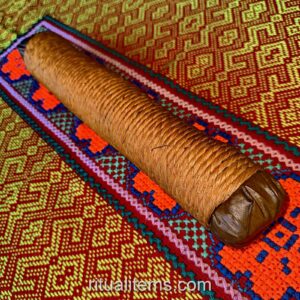 Mapacho is a traditional Amazonian Mapacho name used in parts of Peru, Ecuador and neighboring regions. Depending on the local plant lineage and usage, the name may refer to different Mapacho types, including N_cotiana rustica and N_cotiana T_bacum. In Ecuador, the Mapacho offered by Ritual Items comes from Kichwa families in the Alto Napo region, where the Mapacho is grown in small mixed gardens, formed into dense rolls and traditionally smoke-cured.
This page is focused on Ecuadorian Mapacho: where it comes from, how it is cultivated and cured, how it differs from many Peruvian rolls, and practical information about buying, shipping and storage. For a deeper discussion of the meaning of Mapacho, species, regional terminology, Indigenous cultural context, history and safety, see our complete What Is Mapacho? guide.
Why Ecuadorian Mapacho Is Different
- Kichwa origin: the rolls described here come from Indigenous Kichwa families in the Alto Napo region of Ecuador.
- Small mixed gardens: the plants are grown alongside other useful crops rather than in industrial monocultures.
- No aguardiente: the Ecuadorian preparation we know does not use sugar-cane liquor during processing.
- Smoke curing: completed rolls are gently smoke-cured for roughly two to three weeks over a dedicated wood fire.
- Morete-palm binding: the reusable palm-fiber cord helps keep the roll compressed and makes it easier to retie after cutting.
- Fresh character: finished rolls retain a distinctive earthy aroma and more natural moisture than many fully dried commercial tobakkos.
These details are based on direct observation of the growers and preparation process for the Alto Napo Mapacho supplied to Ritual Items. They describe this Ecuadorian tradition specifically and should not be taken as a universal definition of all Mapacho.
How Ecuadorian Mapacho Is Grown and Prepared
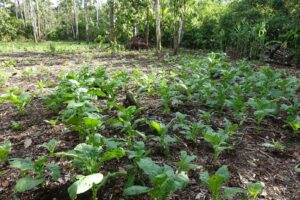 The following is a firsthand description of the Alto Napo crop supplied to Ritual Items, not a claim about every product sold as Mapacho. Jan Rostlinka has repeatedly visited the gardens and the Kichwa family that grows, rolls and prepares this Mapacho.
The Mapacho grows in small mixed gardens rather than industrial monocultures. The growers use no synthetic pesticides, herbicides or fertilizers. No artificial flavors or chemical preservatives are added during processing. “Without synthetic agricultural inputs” does not mean that Mapacho is harmless or free of naturally occurring chemicals such as N_cotine.
Planting and Transplanting the Tiny Seeds
Mapacho seeds are extremely small. There are approx. 10.000 seeds in 1 gram. The Kichwa growers often prepare a nursery patch where a controlled fire has left a clean, ash-rich surface. After rain has moistened the soil, the seeds are sprinkled over this area, where they can germinate readily. Once the seedlings are large enough, they are transplanted into another plot that has been cleared manually with a machete.
Manual Field Care Every Few Days
Growing the crop without synthetic agricultural chemicals is highly labor-intensive. The plants must be checked approximately every one to three days. Large green caterpillars can begin eating the leaves and damage a crop very quickly, so the growers inspect the plants and remove pests by hand. Weeds and surrounding vegetation are also managed manually rather than with herbicides.
Selected leaves are removed by hand so that the remaining leaves can develop more fully. Growers also pinch off the flower heads before the plant directs much of its energy toward flowering and seed production. Mapacho agronomy calls this practice topping; research shows that it changes resource allocation, encourages leaf development and can increase N_cotine accumulation in the remaining leaves. See Agronomic Practices Affecting N_cotine Concentration in Flue-Cured Mapacho.
Drying, Moistening and Forming the Roll
After harvest, the leaves are tied along a line and air-dried, much like clothes hanging to dry. Once they have lost much of their moisture, they are spread over a clean surface and lightly moistened with a special fermented liquid prepared from Mapacho stems. This restores the flexibility needed for rolling and contributes to the family’s characteristic preparation.
The leaves are formed into a dense roll and tightened with cord made from the leaves of the morete palm. As the Mapacho compresses and changes, the family unties and reties the roll in stages to maintain its shape and density.
Smoke Curing Without Aguardiente
The completed roll is smoke-cured for approximately two to three weeks above a dedicated, gentle wood fire. This is not an ordinary cooking or waste fire: food is not prepared over it, plastics and rubbish are never burned, and only selected clean wood is used for the curing smoke.
Unlike some commercial Peruvian rolls, the Ecuadorian preparation we know is made without aguardiente or other alcohol. The finished fresh batches retain a strong earthy aroma and natural moisture.
Why the Morete-Palm Binding Matters
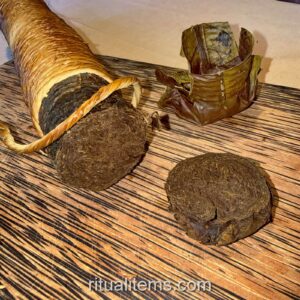 Ecuadorian rolls are tied with a highly resistant cord made from leaves of the morete palm (Mauritia flexuosa), known as aguaje in Peru. The cord withstands the repeated tightening and smoke-curing process. After a roll is opened and a piece is cut away, the same cord can be used to tie the remaining Mapacho securely again.
Many Peruvian rolls we have handled use a strip of bark instead. Once the bark wrapping is opened, it can slip away from the roll and may be difficult to fasten tightly again, leaving the remaining Mapacho less protected and allowing it to lose freshness more quickly.
Many typical Peruvian rolls we have encountered are also not smoke-cured in the same way. Dense, moist Mapacho that has not undergone this curing can be more susceptible to mold. The combination of extended smoke curing and a reusable morete binding helps the Ecuadorian roll keep its shape, protects the cut end and substantially reduces mold risk over time. It does not make storage failure impossible, so correct moisture management remains important. See our complete Mapacho storage guide.
Buying Mapacho Mapacho from Ecuador
How is Mapacho Mapacho shipped?
Our current express shipping option is DHL Express. Shipping availability depends on the destination, carrier acceptance, and local import rules. Most parcels to the United States that are accepted for carriage arrive within approximately 5–10 working days.
How can I pay for a Mapacho order?
Available payment methods may include:
- debit or credit card through the available payment gateway;
- PayPal;
- Western Union;
- bank transfer through Wise;
- transfer through Revolut.
The payment methods shown at checkout are the current options available for your order.
Country restrictions, customs, and import responsibility
 We have more than 15 years of experience shipping traditional Amazonian products internationally. Our delivery success has been very high, but Mapacho import rules, duties, taxes, documentation requirements, and carrier restrictions vary considerably by country and may change without notice.
Some destinations are straightforward, while others may require customs clearance, duties, permits, or may not accept the shipment at all. This is based on our practical shipping experience and should not be understood as an authoritative statement of current customs law.
No problems at all: United States, United Kingdom, Switzerland, Taiwan, Costa Rica
Mostly no problems: European Union except countries listed below, New Zealand.
Quite problematic: Canada (see below), Mexico., Czech Republic, Slovakia.
We never ship to: Australia, Turkey, Russia
Shipping Mapacho to Canada
In Canada, if you have to go into customs, it’s because they already know it’s Mapacho. It is best to get an advance trade ruling for the tariff classification. It falls under “unmanufactured Mapacho since it is composed of cured Mapacho leaves that have been stemmed/stripped but are not ready for smoking, partly or wholly stemmed/stripped.” They see the effort and appreciate it.
Of course they want it labelled Mapacho, but they understand why that is difficult with carriers (DHL cannot deliver Mapacho in Canada and you will need to get it personally).
The duties and taxes may differ a lot in different provinces. In BC, duties and taxes for 1 roll are approx. $550 CDN. In Alberta it may be much less, around $20.
International Shipping, Customs & Import Responsibility
Before ordering, please check whether Mapacho can be legally imported into your country and whether your chosen carrier accepts Mapacho shipments. The customer is responsible for complying with all destination-country import requirements, including any duties, taxes, permits, licenses, or other customs requirements.
There is no guarantee that you will be able to receive the product if customs authorities in your country detain, refuse, or seize the parcel. Customs may also impose additional charges, including import duties, taxes, or handling fees, and it is the customer’s responsibility to pay them.
DHL or another carrier may also refuse to deliver the parcel if the shipment is considered restricted, prohibited, or otherwise undeliverable under the carrier’s rules or local regulations.
In such cases, we cannot offer a refund or accept the parcel as a return. Parcels returned to us may be subject to substantial return-shipping costs, customs charges, and import fees. The customer therefore accepts the risk associated with importing this product into his or her country.
By placing an order, you acknowledge and accept our no-refund and no-return policy in cases involving customs detention, seizure, refusal of entry, unpaid import charges, or carrier refusal. Before shipping your parcel, we may also ask you to confirm that you understand and accept this policy.
Important: International customs clearance cannot be guaranteed. Customs authorities may assess taxes or duties, request additional documentation, refuse entry, or seize goods in accordance with local law. Carriers may also refuse delivery where their own shipping restrictions apply. In such cases, we cannot offer a parcel return or refund. The risk associated with importing the product is the customer’s responsibility. Please review our Terms and Conditions before ordering.
INVOICE AND LABEL
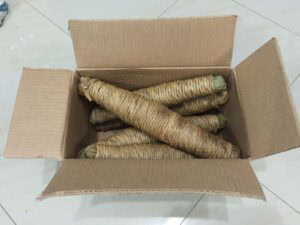
Mapacho Mapacho rolls prepared for international shipping
Ritual Items offers this product exclusively as incense for aromatic and ceremonial burning. Customs authorities and carriers may nevertheless classify Mapacho according to its botanical material and local Mapacho rules. We use an accurate commercial description and the actual order value on shipping documents; we cannot alter the description or declare a different value on request.
Tracking your Mapacho parcel
Shortly after shipping, we send an email confirmation with the tracking number. You can follow the parcel on the DHL tracking website. DHL notifications occasionally end up in spam folders, so please check your spam folder if you have not seen a tracking message.
Mapacho Mapacho from Ecuador FAQ
What is Mapacho?
Mapacho is a traditional Amazonian name for strong tobakkoo used in different regional and Indigenous contexts. The term is not limited to one standardized species or preparation. On this page, Mapacho refers specifically to the Ecuadorian Kichwa-grown Mapacho rolls supplied to Ritual Items from the Alto Napo region. For the broader botanical, historical and cultural explanation, see our What Is Mapacho? guide.
Is this Ecuadorian Mapacho organic?
Our Mapacho is grown in small rainforest permaculture gardens belonging to Kichwa Indigenous families in Napo Province, far from large cities and industrial agriculture. The growers do not use synthetic pesticides or chemical fertilizers; fire ash may be used to fertilize the soil, and harmful insects are removed by hand.
The Mapacho grows alongside medicinal plants and food crops rather than in large monoculture fields. No artificial flavors or other additives are added when the rolls are made. The finished rolls are gently smoke-cured above the household fire.
We describe this Mapacho as organically grown and additive-free. Unless explicitly stated for a particular batch, this refers to the traditional growing method rather than third-party organic certification.
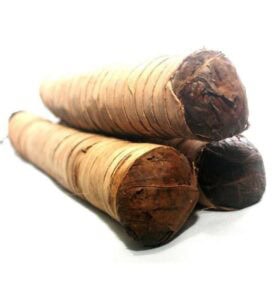
Classic Peruvian Mapacho Mapacho roll
What is the difference between Ecuadorian and Peruvian Mapacho?
There is no single recipe for Mapacho throughout the Amazon. Preparation varies by region, family and producer.
Our Kichwa producers in Ecuador do not use aguardiente (sugar-cane liquor) when making the rolls. The resulting Mapacho is generally earthier and less sweet or perfumed than many Peruvian rolls we have handled.
The binding is another practical difference. Ecuadorian rolls are tied with a highly resistant cord made from morete-palm leaves (Mauritia flexuosa). It can be untied when Mapacho is cut and then reused to secure the roll. Many Peruvian rolls use bark wrapping that can slip away once opened and may be difficult to fasten tightly again, leaving the cut roll less protected and allowing it to lose freshness more quickly.
The Ecuadorian rolls are also gently smoke-cured for approximately two to three weeks, while many typical Peruvian rolls we have encountered are not cured over fire in the same way. Extended smoke curing lowers excess moisture and, together with the reusable morete binding, substantially reduces mold risk and improves keeping quality. It does not remove the need for correct storage.
Can Mapacho be N_cotiana rustica or N_cotiana T_bacum?
Yes. Mapacho is a regional cultural name and, depending on the plant lineage and local usage, may refer to N_cotiana rustica or N_cotiana T_bacum. Because the Ecuadorian crop offered here has not been formally identified through taxonomic or genetic analysis, we do not claim one confirmed species; read What Is Mapacho? Meaning, Species and Indigenous Amazonian Use for the full botanical discussion.
How should I store Mapacho?
Our Ecuadorian rolls are shipped fresh and retain more moisture than fully dried commercial Mapacho. This helps preserve their characteristic aroma but also means that improper storage can encourage mold.
For long-term storage, divide the roll into smaller portions, package them airtight, and freeze the portions you will not use soon. For short-term use, keep Mapacho cool, dark, and protected from excessive moisture. Do not seal very wet Mapacho at room temperature, and avoid repeatedly drying it in strong sun if your goal is to preserve its fragrance.
See the complete instructions in our guide to storing Mapacho while preserving freshness, strength, and aroma.
Meaning, Species and Traditional Context
Mapacho is a regional Amazonian name rather than one standardized species or product. Depending on the region and plant lineage, it may refer to N_cotiana rustica or N_cotiana T_bacum, and Indigenous names and traditional ceremonial practices vary widely between peoples.
This Ecuador guide focuses on origin, cultivation, curing, buying, shipping and the practical differences between Ecuadorian and Peruvian rolls. For the full discussion of etymology, species, regional names, traditional forms, cultural uses, history, research and safety, read What Is Mapacho? Meaning, Species and Indigenous Amazonian Use.
